
Ranson sits right alongside Charles Town in Jefferson County, and shares the same water profile — a mix of municipal customers and private wells within just a few miles of each other. Well water is still common outside the newer developments, but Ranson has seen a real homebuilding boom over the past several years, and a lot of those new neighborhoods are on city water rather than wells — served by either the Charles Town Utility Board or West Virginia American Water, depending on the specific neighborhood or annexed area. Hard water is the norm on both systems; a carbon-filtered water softener setup is the usual fix.
A hidden problem in new construction: dangerously high night-time water pressure
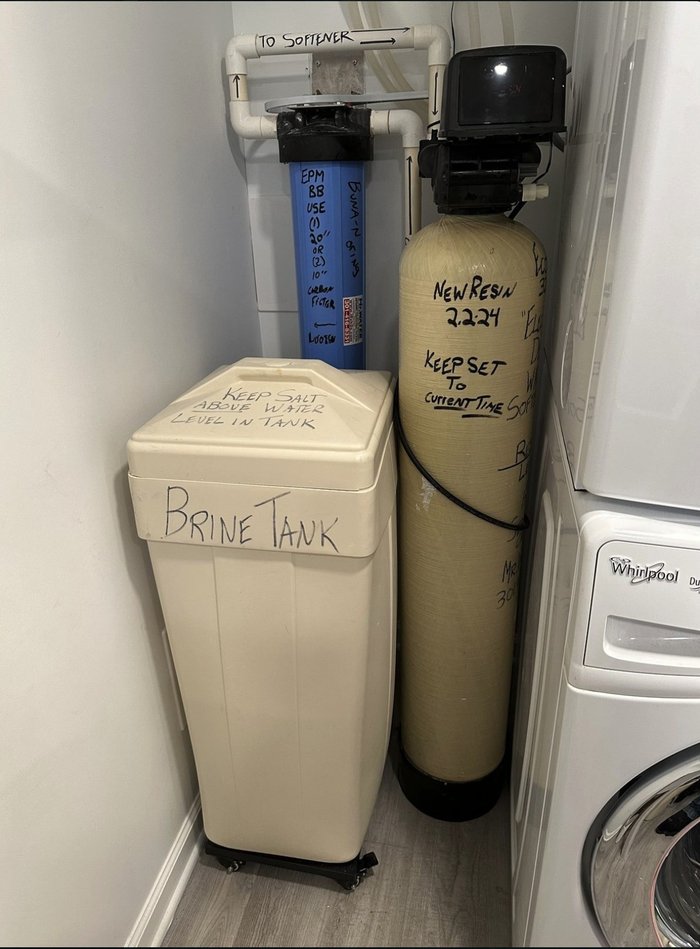
One issue Scott has found repeatedly in Ranson's newer homes on municipal water is water pressure that spikes well above normal at night, when neighborhood usage drops. He's measured over 180 psi in these overnight spikes — more than double what's typical for a home. Most municipal water systems are designed around daytime demand, and when that demand falls off after everyone's asleep, pressure in the line can climb sharply if nothing on the house side is regulating it.
Most homes built in this area use CPVC piping, and a lot of it is FlowGuard Gold — a good, reliable product rated (right on the pipe itself) to handle up to 450 psi, so the pipe itself usually isn't in immediate danger. The real risk is everything connected to it: fittings, valves, appliance connections, and especially a water softener, which is not built to the same pressure tolerance as the pipe. Repeated overnight spikes into the 180+ psi range put constant stress on a softener's tank and internal valve, and it's the kind of thing that can eventually cause a softener to fail catastrophically — Scott has seen it happen.
The problem is a lot of these newer Ranson homes were never fitted with a PRV (pressure reducing valve) during construction. Like high blood pressure, you don't know it's there until someone actually tests for it — there's no obvious daytime symptom, since the spike only shows up overnight when nobody's running water or watching a gauge. Left unaddressed, it doesn't just risk the softener; it quietly shortens the life of the whole plumbing system over time.
If you're in a newer Ranson home on city water, it's worth having your static pressure checked, especially overnight. If a PRV isn't already installed, it's a straightforward fix that protects both your plumbing and any water treatment equipment down the line.
For well owners around Ranson, the same limestone-driven hard water common across the Eastern Panhandle shows up here too, along with the occasional iron or sulfur (rotten-egg smell) well. Sediment filters, softeners, and odor-removal systems sized to an actual water test are the usual fix — not a one-size-fits-all unit.
Send photos of your equipment or water problem through the contact form and Scott will give you a straight read on what's actually needed before scheduling a visit.
Check out our prices here.
Water Treatment System Repair in Ranson
Need service on an existing system in Ranson or Jefferson County? We repair softeners, iron filters, neutralizers, and more, regardless of brand. See our repair & service page.