
Falling Waters sits in northern Berkeley County right along the Potomac, and the well water here is some of the most inconsistent in the whole Panhandle. The underlying geology shifts a lot over short distances — limestone in some spots, shale and sandstone in others — so well depth, hardness, iron, and odor can all look completely different from one property to the next, even between neighbors on the same road.
That inconsistency has made Falling Waters a magnet for here-today-gone-tomorrow water treatment outfits. Scott has been out to more homes than he can count where a system got installed by a company that's since gone out of business, stopped answering the phone, or simply doesn't service this area anymore — leaving the homeowner with equipment nobody will stand behind, and often equipment that was never matched to what was actually in the water to begin with. A generic softener dropped in without real testing doesn't fix problem water; it just adds a monthly salt bill on top of a problem that's still there.
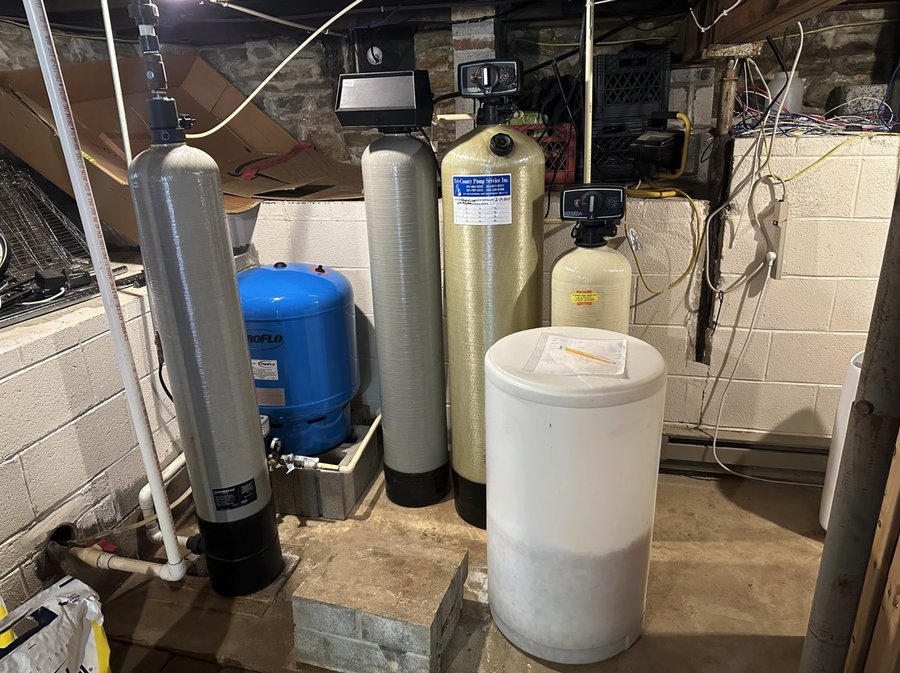
This Falling Waters basement is a real example of that pattern — and also of the right way to handle it. This system is a sediment filter, a well pressure tank, a softener, an older iron/sulfur filter, and a second smaller tank, all sitting side by side, clearly installed piecemeal over time as one fix after another was added to try to get the water acceptable. Scott's patented all-in-one system would have replaced this entire lineup with a single unit — but that wasn't in this customer's budget. So instead of pushing a sale the homeowner couldn't afford, Scott diagnosed and repaired the equipment that was already there and got it working properly, tank by tank, at a fraction of the cost of a full replacement. That's the difference between a company selling a box and a company solving your water: sometimes the right answer is a new system, and sometimes it's making the five systems you already paid for finally do their job.
A problem that's easy to get wrong: high pH with hydrogen sulfide
One of the more unusual water conditions Scott has run into repeatedly around Falling Waters is hydrogen sulfide — sulfur odor — combined with highly alkaline water. Most people assume sulfur smell and high pH don't go together, but here they do, and it changes the whole approach to treatment.
Hydrogen sulfide gas wants to stay dissolved in water once the pH climbs above roughly 7 to 7.5 — the more alkaline the water gets, the more stubbornly the sulfur stays in solution instead of venting off or reacting where standard oxidation methods expect it to. Scott has tested Falling Waters wells running 8.5 to 9 pH with sulfur odor present, which is a genuinely difficult combination. Treatment approaches that work fine on normal, moderate-pH sulfur water can underperform or fail outright on water this alkaline, which is exactly the kind of well that ends up with two or three different systems installed over the years by two or three different companies, none of which solved it.
This is a case where guessing gets expensive. It takes real testing and equipment sized and configured for the actual pH and sulfide levels in front of you — not a one-size-fits-all softener — to get it right the first time.
If you're in Falling Waters and dealing with sulfur odor, staining, or a system that was installed by someone who's no longer around to service it, send photos of your current setup and any water test results you have through the contact form. Given how much the water varies here, a real look at your specific well matters more than it does almost anywhere else in the service area.
Check out our prices here.
Water Treatment System Repair in Falling Waters
We repair and service water treatment equipment throughout Falling Waters and Berkeley County — softeners, filters, neutralizers, and more, regardless of who installed it. See our repair & service page for details.