
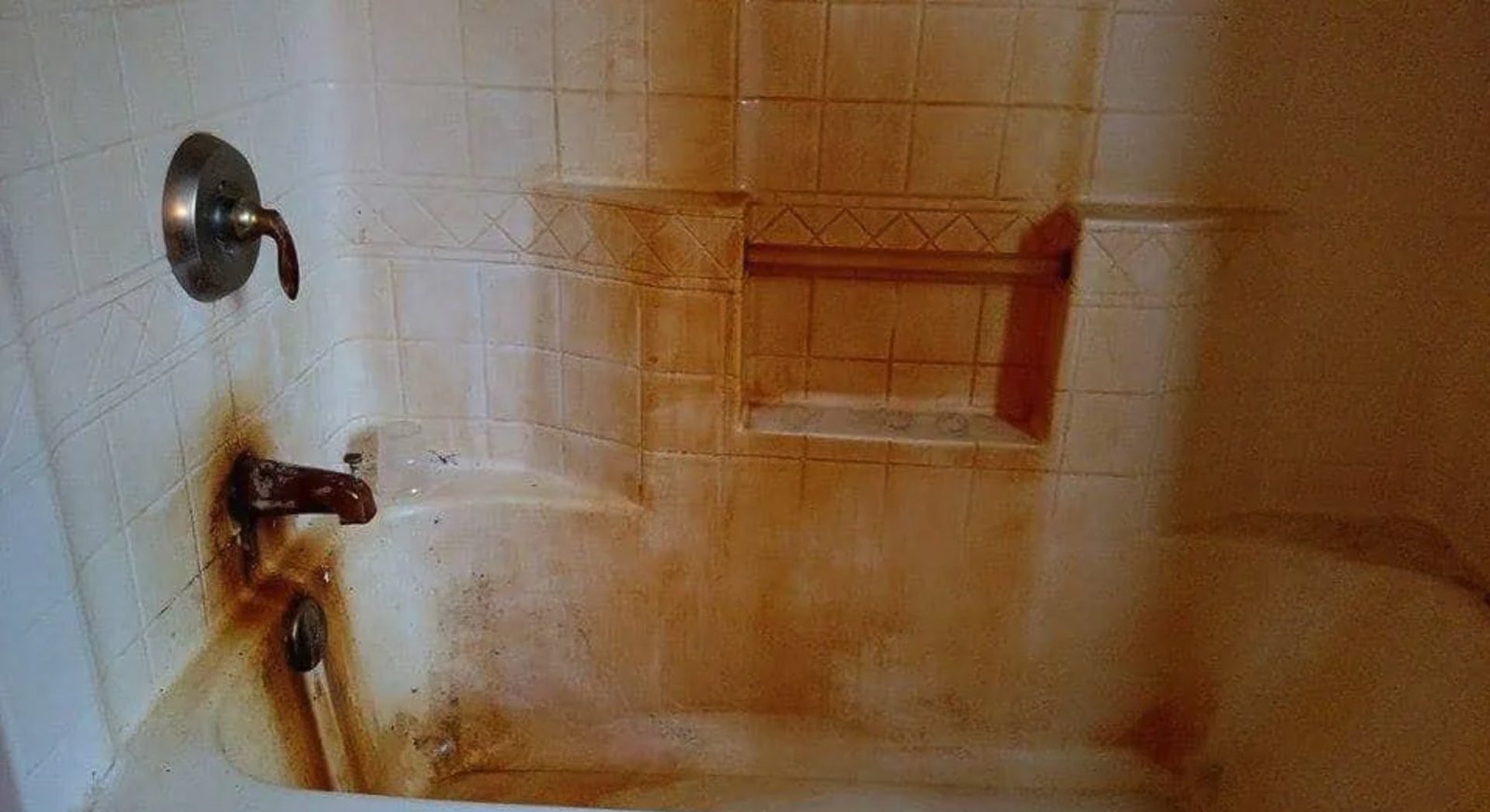
Untreated iron in well water staining a tub and shower surround orange and brown.
If you have orange or rusty stains on your sinks, tubs, toilets, or laundry, the culprit is almost always iron in your well water. It is one of the most common complaints we hear from homeowners across Central Maryland, the West Virginia Panhandle, Northern Virginia, and Southern Pennsylvania — and the good news is that it is very fixable, once you understand what kind of iron you are dealing with.
Iron is not a health hazard at the levels found in most well water, but it is a nuisance that gets worse over time. It stains everything it touches, gives water a metallic taste, clogs plumbing and appliances, and can even feed the bacteria that cause that rotten-egg smell. Here is how to identify it and what actually fixes it.
How to Tell If You Have Iron in Your Well Water
You usually do not need a lab to suspect iron. The classic signs are hard to miss:
- Orange, red, or brown staining on sinks, tubs, toilets, and shower tile
- Rust-colored spots on white laundry — sometimes worse after using bleach
- A metallic or "blood-like" taste to the water
- Water that looks clear from the tap but turns orange after sitting in a glass or a toilet tank
- Reddish-brown slime or sludge in toilet tanks and on fixtures
- Reduced water pressure over time as iron builds up inside pipes and water heaters
The only way to know exactly how much iron you have — and what is coming along with it — is a water test. A proper analysis measures iron, manganese, hardness, pH, and more, which is what tells us how to size the right system.
The Three Types of Iron — and Why It Matters
"Iron" is not one single problem. The form your iron takes determines how we treat it, which is why a system that works great at one house fails at another.
Ferrous iron (clear-water iron). This iron is fully dissolved, so the water looks perfectly clear straight from the tap — then turns orange as it sits and the iron meets air. At low to moderate levels, a properly sized water softener can remove it along with your hardness.
Ferric iron (red-water iron). This iron has already oxidized, so the water looks rusty or orange the moment it comes out of the tap. It needs to be physically filtered out, usually with an oxidizing iron filter or an aeration system rather than a softener alone.
Iron bacteria. These naturally occurring microorganisms thrive in iron-rich wells. They are not a direct health risk, but they produce slimy reddish-brown buildup, staining, and odors, and they can foul treatment equipment. Iron bacteria often need a well "super chlorination" to knock them back, in addition to the right filtration.
Manganese frequently rides along with iron and causes its own black or dark-brown staining. When iron, manganese, hardness, and sometimes hydrogen sulfide all show up together — which is common in our region — you need a system designed to handle the whole combination, not just one piece of it.
Why Iron Is So Common in Maryland and WV Well Water
The geology of Central Maryland and the Eastern Panhandle of West Virginia is rich in iron-bearing rock and soil. As groundwater moves slowly through these formations, it dissolves iron and carries it into private wells. That is why iron staining is so widespread here, and why two homes on the same road can have very different water depending on well depth and the formations each one draws from. It is also why off-the-shelf, one-size-fits-all systems so often disappoint — they are not built around your specific water.
What Iron Does to Your Home Over Time
Left untreated, iron does more than stain. It builds up as scale inside your water heater and pipes, slowly choking flow and shortening the life of expensive appliances. It fouls dishwashers and washing machines, ruins laundry, and leaves that stubborn orange ring in every toilet. And because iron feeds certain bacteria, an iron problem left alone can eventually turn into an odor problem too. Fixing it early protects your plumbing and your fixtures.
How We Remove Iron from Well Water
There is no single "iron filter" that is right for every home. We test your water, measure the iron type and level along with everything else, and build a system around it. The most common solutions we install are:
- A properly sized water softener for low-to-moderate clear-water (ferrous) iron, which it removes right along with your hardness.
- Air injection / aeration systems that oxidize higher iron levels so they can be filtered out — no chemicals required.
- Our patented Water Softener with Closed Pressure Aeration when you have the "triple threat" of iron, hardness, and sulfur (rotten-egg smell) together — it handles all three in one compact, low-maintenance system.
- Well super chlorination to knock down iron bacteria infestations and reduce ongoing maintenance.
- Sediment pre-filtration to capture oxidized iron particles and protect the rest of your system.
If your iron problem also comes with a sulfur smell, our companion guide on why your well water smells like rotten eggs explains how the two are connected and how we treat them together.
Frequently Asked Questions
Will a water softener remove iron from my well water?
A properly sized water softener removes low-to-moderate ferrous (clear-water) iron along with hardness. Higher iron levels, ferric (red-water) iron, or iron bacteria usually need aeration or an oxidizing iron filter in addition to softening.
Is iron in well water dangerous to drink?
At the levels found in most well water, iron is a nuisance rather than a health hazard — but it stains fixtures and laundry, affects taste, and can damage plumbing and appliances over time.
Why does my water look clear but still leave orange stains?
That is classic ferrous (clear-water) iron. It is dissolved and invisible from the tap, then turns orange when it meets air and oxidizes — which is why stains show up in toilets, tubs, and glasses of water left to sit.
Can you remove the orange stains that are already there?
Treating the water stops new staining. Existing stains can usually be cleaned with iron-specific cleaners once the source is under control.
Do you service my area?
Yes. We serve Central Maryland, the West Virginia Eastern Panhandle, Northern Virginia, and Southern Pennsylvania.
Get Your Iron Problem Fixed for Good
Orange stains do not have to be a fact of life on well water. We have been diagnosing and solving iron, hardness, and sulfur problems across the region since 2005, and we will tell you exactly what is in your water and what it takes to fix it — with no commission-driven upsells. Call Mr. Water LLC at (301) 416-8331 or request a quote through our contact form. Clean, clear, stain-free water — guaranteed.